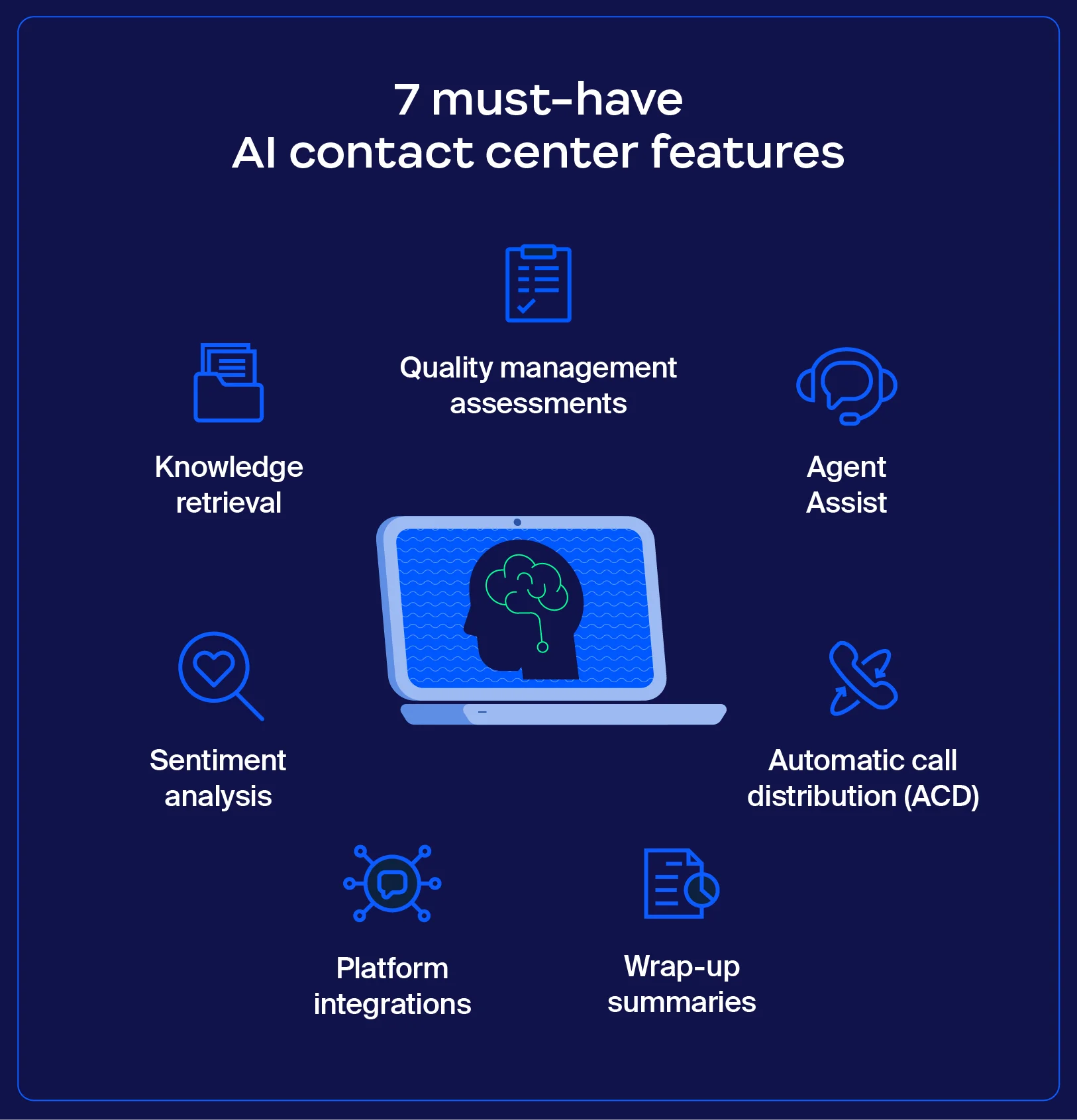
AI contact center software provides a wide range of useful features to assist call center agents, managers, and customers. Understanding these features is helpful to employ this technology in your call center.
1. Quality management assessments
Quality management is an integral part of running a successful call center because quality managers can provide valuable feedback to agents, like the best way to de-escalate a call. Unfortunately, due to the number of calls that come through a call center on any given day, it’s unrealistic for quality managers to review each call individually.
AI can help contact centers with quality management by combing through entire call transcripts and creating simplified summaries with suggestions for improvement. This gives quality managers more time to focus on coaching agents rather than reviewing calls, and it’s so effective that 66% of call center supervisors report improved quality management as of 2024.
2. Agent assistance
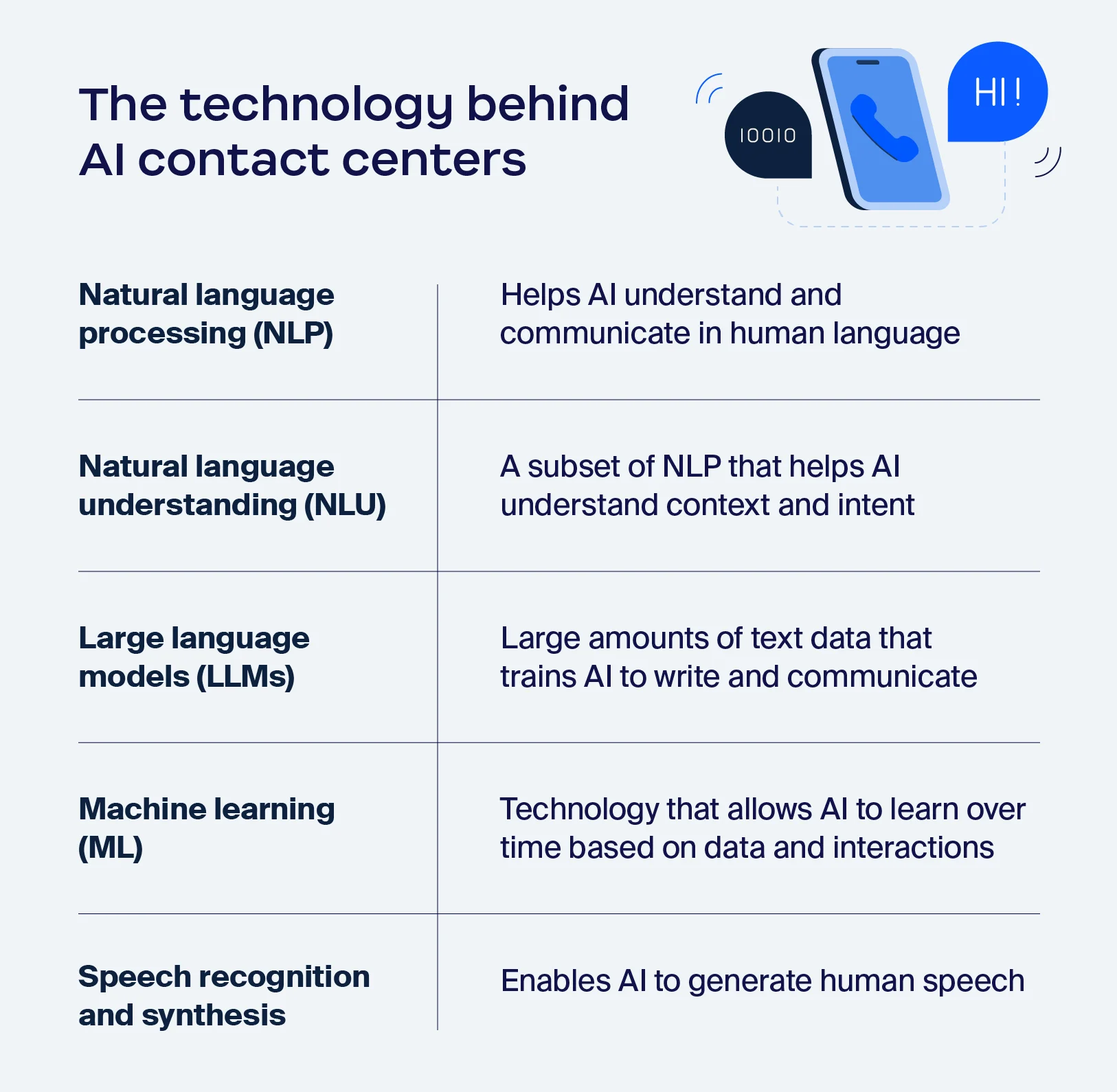
Agent assistance supports live agents during customer conversations by listening and analyzing context to offer guidance in real time. This feature, powered by LLMs, can suggest responses or appropriate next steps without interrupting the call’s flow. Using this tool, the agent can stay focused and reduce manual lookups and after-call work.
Suppose a customer calls about a billing dispute that includes multiple products. As the conversation goes on, the agent assist picks up on key phrases and pulls related policies. It then suggests a clear explanation that the agent can adapt how they see fit. Plus, it can prompt the agent to ask follow-up questions or summarize the interaction for later use.
Adoption is picking up quickly, with 64% of companies already using this feature or having plans to use it in 2025. Organizations using it report 64% greater employee efficiency, 60% reduced costs (alongside 49% higher revenue growth), and 39% better CSAT scores.
Zoom’s AI Expert Assist provides a strong example of an AI assistance tool. It offers real-time guidance during live conversations, surfaces relevant knowledge, and helps agents respond more efficiently without putting customers on hold.
3. Automatic call distribution (ACD)
Automatic call distribution (ACD) is the technology that matches the customer with an agent who has the unique skills to help them. For example, you may have bilingual agents who can communicate in different languages or have expertise in specific areas. With ACD, AI can assess what the customer needs and direct them to the agent best suited to meet those needs, saving time and providing the customer with a better experience.
ACD isn’t just for directing calls, either. An AI contact center has routing capabilities that integrate with all of your communication channels. Whether a customer calls, emails, or texts, the AI can direct them to an available agent with the best skills for the situation.
4. Wrap-up summaries
After each call, agents write wrap-up summaries to recap what happened on the call. This helps the next agent who works with the customer know where the last agent left off. While these summaries are necessary, writing them by hand takes up time that the agent could spend helping the next customer.
AI can decrease the time needed for this task by generating a summary of each call once it’s complete. According to a 2024 report from Metrigy and Zoom, generative AI summarizations help agents save 35% after-call time. Previously, agents spent 16.2 minutes on summary generation, which AI helped reduce to 10.4 minutes. Then the agent simply needs to review it for accuracy before moving on to the next customer interaction. With this Zoom CX feature, we’ve seen a 50% decrease in time spent on wrap-up summaries for customers.
5. Integration with other platforms
Call centers use a variety of platforms, such as CRMs, knowledge bases, and ticketing systems. Whenever you adopt a new form of technology, you want to be sure it works seamlessly with the platforms you’re already using. AI contact centers provide that functionality.
AI contact center software often integrates with popular CRM platforms. Whether it’s Salesforce, Zendesk, or PCI Pal, you can set up your AI contact center to work with them and utilize valuable tools like wrap-up summaries and agent assist.
6. Sentiment analysis
Sentiment analysis is the technology that enables AI to understand how customers feel when they call by analyzing context and tone.
During a conversation, sentiment analysis can alert the agent if a customer is becoming upset in real time. It can then provide the agent with information and suggestions via agent assist. This can also help with detailed wrap-up summaries and quality management by informing you of the customer’s mood throughout an interaction.
7. Knowledge retrieval
Knowledge retrieval is the contact center’s ability to search for information across sources such as previous calls, standard operating procedures, and FAQs to help agents answer questions quickly. This feature helps limit the need to put customers on hold, keeping them happy and reducing frustration.
AI can also power contact centers with chatbots that answer simple customer questions. Knowledge retrieval helps chatbots answer a broader range of questions, freeing agents to work with customers who require a human touch.









 6 min read